


In the collective imagination, orthodontics is prisoner to an archaic model: a reactive vision that requires waiting for the appearance of all permanent teeth except the wisdom teeth, around 13 years old more or less, in order to urgently align a rigid dental structure using braces, or even sometimes heavy and costly surgery. Waiting for …


In the collective imagination, orthodontics is prisoner to an archaic model: a reactive vision that requires waiting for the appearance of all permanent teeth except the wisdom teeth, around 13 years old more or less, in order to urgently align a rigid dental structure using braces, or even sometimes heavy and costly surgery.
Waiting for the jaws to be very advanced in their growth only amplifies the difficulties of treatment. Modern dentofacial orthodontics demands a radical paradigm shift through the concept of interceptive treatment.
It is precisely this concept of interceptive treatment, from early childhood, that we practice at Bellevue Dental Ltd: comprehensive care to guide the child’s bone and functional growth at the exact moment when maxillary growth is most active. Everything happens right there.
1. The Window of Opportunity: Why Act From Early Childhood
From a biological standpoint, the jaws combine active bone growth with maximum skeletal malleability.
Detecting a skeletal discrepancy or disharmony at this age makes it possible to steer growth rather than undergo it. Thus, ignoring this period amounts to closing the door on this opportunity. Isn’t it said that prevention is better than cure?
The diagnosis of original dysfunctions
Severe crowding, an atrophic jaw, or a crossbite observed in early childhood are not merely aesthetic anomalies. They are potential structural brakes compromising the development of:
- Skeletal growth of the jaws and the base of the skull.
- The balance of the temporomandibular joints (TMJ).
- Facial morphology and overall body posture.
2. Interceptive Treatment vs. Secondary Treatment
- Interceptive treatment, or dentomaxillofacial orthopedic treatment, is performed in young children before 10–11 years of age.
Beyond aesthetics, early orthopedics is a matter of systemic health. It enables the early screening and treatment of parafunctions and deleterious habits (such as mouth breathing, thumb sucking, atypical swallowing, and tongue posture, among others). This treatment corrects growth anomalies of the face and the base of the skull, creating space to facilitate the eruption of upcoming permanent teeth.
Following interceptive treatment, the patient may not require orthodontic treatment at all. And if orthodontic treatment is necessary, it will be short, streamlined, and relapses will be nonexistent or very minimal.
- Orthodontic treatment: This is limited to precise cosmetic alignment. Here, orthopedic problems and parafunctions are not always addressed, and for optimal treatment, surgery or dental mutilation (stripping, extraction) are very often required.
This treatment corrects crowded teeth, improves brushing and chewing, prevents abnormal tooth wear, closes excessively wide spaces, and in the vast majority of cases, uses surgery to correct jaw discrepancies. Relapses are very frequent for orthodontic treatments that do not follow early treatment.
3. A Practical Case Study: Mayla’s Follow-up and Interceptive Treatment
- Date of birth: 10/08/2016
- Date of first consultation: August 2020 (at 4 years of age)
- Reason for consultation: Check-up
- Anamnesis: No known history of allergies, no thumb sucking, no trauma.
Clinical examination (August 2020):
- Elongated face
- Mandible oriented forward and downward
- Endomaxillia (narrow upper jaw)
- All milk teeth present
- Rotated teeth, maxillary diastema
- Low tongue posture
- Agenesis of a lower incisor
- Crowding
Panoramic analysis (August 2020 – 4 years old):
- Wisdom tooth buds are not present.
- The tooth buds of the upper permanent canines and premolars are developing in a bunch (packed tightly next to each other).
- No space for the eruption of the upper permanent canines and premolars.
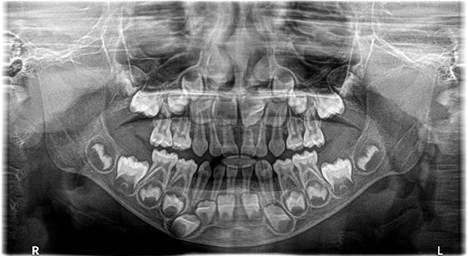
2020
Diagnosis:
These clinical and radiological observations are the consequence of deficient growth of the upper maxilla. This growth deficiency is primarily due to genetic and hereditary factors.
Initial treatment plan:
To avoid surgical interventions later on, orthopedic treatment must begin now. It consists of a three-dimensional expansion plate to be activated every 2 days and tongue retraining through exercises explained to the patient.
Evolution and Follow-up:
- June 2023: The patient returns 3 years after the plate was fitted. She lost it and therefore has not been wearing it. The panoramic x-ray shows the loss of the upper milk canines and molars and a reduction in space for the replacement teeth. The presence of upper wisdom tooth buds is also noted.
- Treatment plan: Three-dimensional expansion plate to be activated every 2 days.
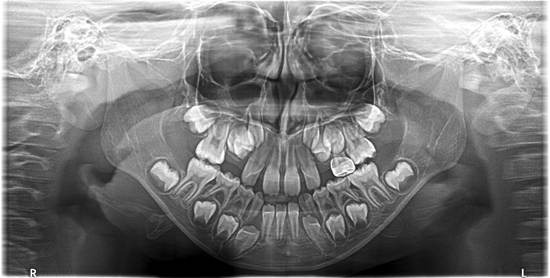
2023
- February 2024: Mayla has worn her appliance a bit more. The panoramic x-ray shows the presence of all wisdom tooth buds. The buds of the upper permanent canines and premolars are still developing in a bunch but have slightly more space for eruption.
- Treatment plan: Continue wearing and activating the three-dimensional expansion plate.
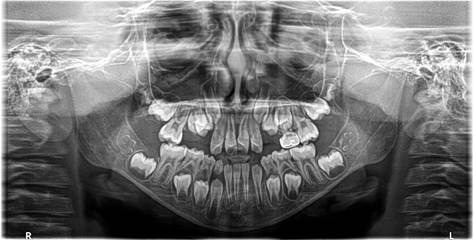
2024
- February 2025: Even more space is noted for the eruption of the upper permanent canines and premolars. The only remaining milk teeth are the lower second molars.
- Treatment plan: Continue wearing and activating the plate.
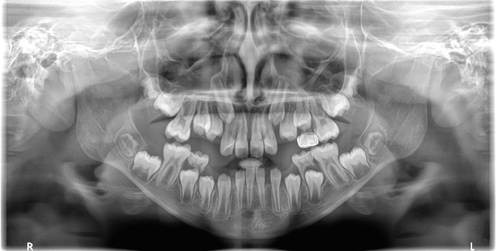
2025
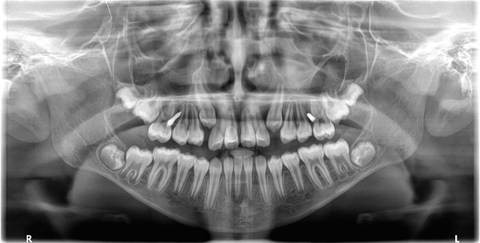
- October 2026: Very good expansion. We are still missing a few millimeters for the eruption of the upper canines. All milk teeth have fallen out.
- Treatment plan:
- Mini-implants for maxillary traction using a Delaire face mask
- Extraction of lower wisdom teeth
- Fixed appliances (braces)
- Make space for the upper canines by distalizing the molars and premolars
2026
4. Conclusion
Anticipating dysmorphoses from early childhood meets precise physiological imperatives: preserving upper airway freedom, ensuring continuous nasal breathing, and securing functional mastication.
Acting at the exact moment when bone growth offers maximum plasticity spares years of complex corrective therapies, superfluous physical constraints, avoidable financial burdens, and, above all, relapses.
Taking control of this growth from early childhood goes far beyond the simple question of dental alignment. It means structuring, starting today, the respiratory, functional, and architectural balance that will accompany the child throughout their growth.


